 By Monir Hossen
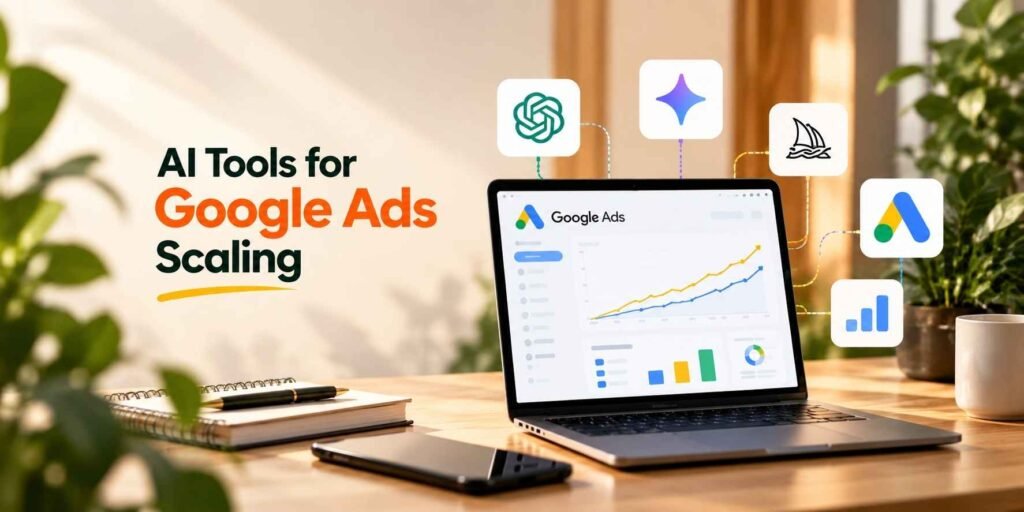
Scaling a Google Ads account is not as simple as increasing the daily budget. As campaigns grow, advertisers need to manage more searches, bids, ads, audiences, landing pages, and conversion data. Doing all of this manually can become difficult and time-consuming.
This is where artificial intelligence is becoming increasingly important in paid search. Google has introduced several AI-powered features that can help advertisers find relevant searches, adjust bids, improve ad messaging, and expand campaign reach.
For businesses looking for AI tools for Google Ads scaling, the goal should not be to automate everything. Instead, AI should be used to handle complex and repetitive optimization tasks while advertisers maintain control over strategy, tracking, budgets, and business goals.
Why AI Is Becoming Important for Google Ads Scaling
Google Ads processes a large amount of information during every auction. User searches, device, location, time, previous interactions, and many other signals can influence whether an ad should appear and how much an advertiser should bid.
AI can process these signals much faster than a person can manually evaluate them.
Google’s Smart Bidding, for example, uses AI to optimize bids for conversions or conversion value at auction time. Current Smart Bidding strategies include Target CPA, Target ROAS, Maximize Conversions, and Maximize Conversion Value.
This can become particularly useful when an account has enough reliable conversion data and the advertiser wants to expand without manually adjusting thousands of individual bids.
1. AI Max for Search Campaigns
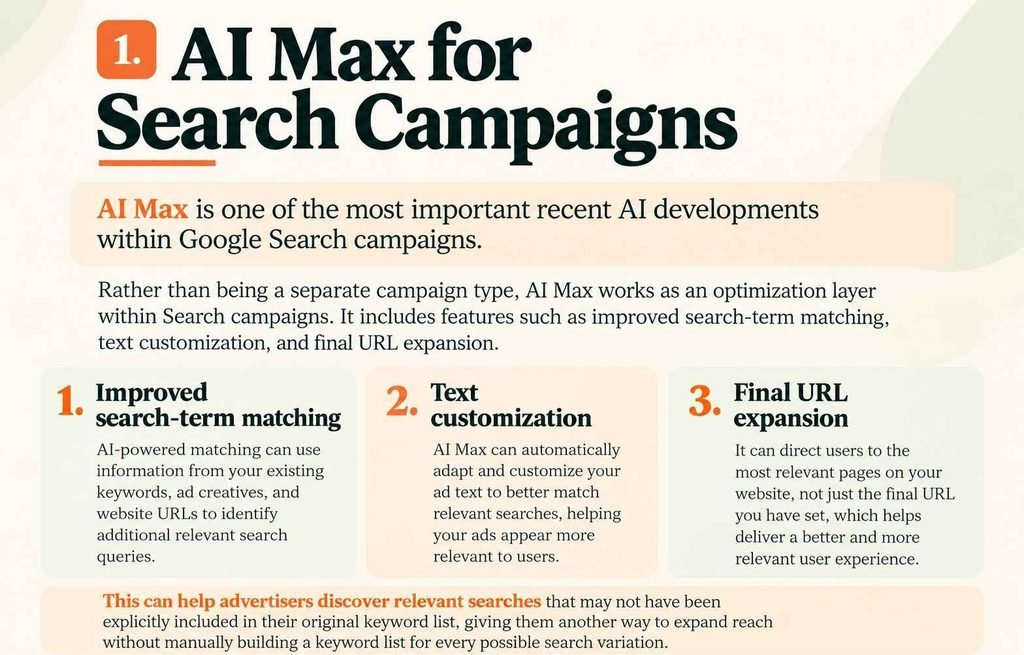
AI Max is one of the most important recent AI developments within Google Search campaigns.
Rather than being a separate campaign type, AI Max works as an optimization layer within Search campaigns. It includes features such as improved search-term matching, text customization, and final URL expansion.
This can help advertisers discover relevant searches that may not have been explicitly included in their original keyword list.
For example, an advertiser may have a group of keywords related to a specific service. AI-powered matching can use information from the existing keywords, ad creatives, and website URLs to identify additional relevant search queries.
This gives advertisers another way to expand reach without manually building a keyword list for every possible search variation.
2. Smart Bidding for Automated Bid Optimization
Increasing campaign spend means there are more auctions to manage. Manually deciding the appropriate bid for every situation is not practical at scale.
Smart Bidding addresses this by using Google AI to make auction-level bidding decisions based on the advertiser’s selected conversion goal.
For lead generation, an advertiser may focus on maximizing conversions or achieving a target cost per acquisition. For ecommerce campaigns, conversion value and return on ad spend can be more important.
Google also provides value-based bidding, which allows campaigns to optimize toward the value different conversions bring to a business rather than treating every conversion as equal.
This is important for scaling because more conversions are not necessarily better if the additional conversions have little business value.
3. AI-Powered Search Term Expansion
Keyword expansion has traditionally required extensive research and manual analysis.
Google’s AI Max search-term matching can expand beyond an advertiser’s existing keyword coverage using broad match and keywordless technology. Google says the system uses available signals to understand the intent behind searches and identify relevant opportunities.
This can be useful when a campaign has already established a strong foundation and the advertiser wants to discover additional demand.
However, expansion should still be monitored carefully. Search-term reports and conversion data remain important because additional traffic does not automatically mean additional qualified leads or profitable sales.
4. AI for Ad Copy and Creative Optimization
Creating multiple relevant variations of headlines and descriptions can take significant time, especially when managing many campaigns.
AI Max includes text customization features that can adapt ad messaging based on a user’s search context. It can also work with final URL expansion to connect users with relevant pages on a website.
This creates opportunities for more personalized ad experiences while reducing some manual work.
Still, advertisers should review the messaging, brand language, offers, and landing-page relevance. AI-generated variations should support the advertising strategy rather than replace human oversight.
5. Performance Max and AI Automation
Performance Max uses Google’s automation across multiple Google advertising channels. It combines automated bidding, targeting, and creative optimization around the advertiser’s selected business objectives.
For businesses with sufficient conversion data and suitable creative assets, this can be another way to find incremental opportunities beyond traditional Search campaigns.
The important point is that automation should be connected to meaningful conversion goals. If the conversion setup is inaccurate, the campaign may optimize toward actions that do not represent real business value.
That makes conversion tracking an essential part of any scaling strategy.
6. AI Max Experiments for Testing Before Scaling
One concern with AI-powered campaign changes is knowing whether a new feature actually improves performance.
Google provides AI Max experiments that allow advertisers to test AI Max features against the existing Search campaign setup before applying the change more broadly. Google describes these experiments as a way to test AI Max features while keeping the control and trial within the same campaign.
This is useful because scaling should be based on evidence rather than assumptions.
For example, an advertiser could test AI-powered search-term matching and compare conversion volume, conversion value, CPA, or ROAS against the existing setup.
Google’s broader Experiments platform also supports structured testing across Search, Display, Performance Max, and other campaign types.
7. AI and Conversion Data Work Together
AI optimization is only as useful as the data it receives.
Suppose a lead-generation company tracks every form submission as a conversion, including low-quality or accidental submissions. An automated bidding system may learn that these actions are valuable because they are being reported as conversions.
That can create a scaling problem.
Before increasing advertising spend, advertisers should review:
- Which actions are counted as conversions
- Whether phone calls are tracked correctly
- Whether lead forms are measured properly
- Whether conversion values represent business value
- Whether offline sales data can be connected to advertising
- Whether duplicate conversions are being recorded
Google’s own guidance recommends aligning Search strategy and bidding with accurate conversion measurement and meaningful business outcomes.
8. Keyword Planner Still Has a Role
AI does not eliminate traditional research.
Google Keyword Planner can help advertisers discover new keyword ideas, review estimated search volume, and understand potential costs. It can also provide forecasts based on different budgets and bidding settings.
This information can be combined with AI-powered campaign features.
For example, Keyword Planner can help identify broader market demand, while AI-powered Search features can help the campaign respond to changing search behavior and find additional relevant queries.
The combination can be more useful than relying entirely on either manual research or automation.
9. AI Does Not Replace Google Ads Management
Automation can handle many optimization decisions, but it does not replace strategic account management.
An experienced advertiser still needs to decide:
- Which services or products should receive more budget
- Which locations should be targeted
- What constitutes a qualified conversion
- Which offers should be promoted
- When to increase or reduce budgets
- Which landing pages need improvement
- Which campaigns should be tested
- When automated recommendations should be accepted or rejected
This is where Google Ads management remains important.
AI can process large amounts of campaign data, but business strategy still requires human judgment.
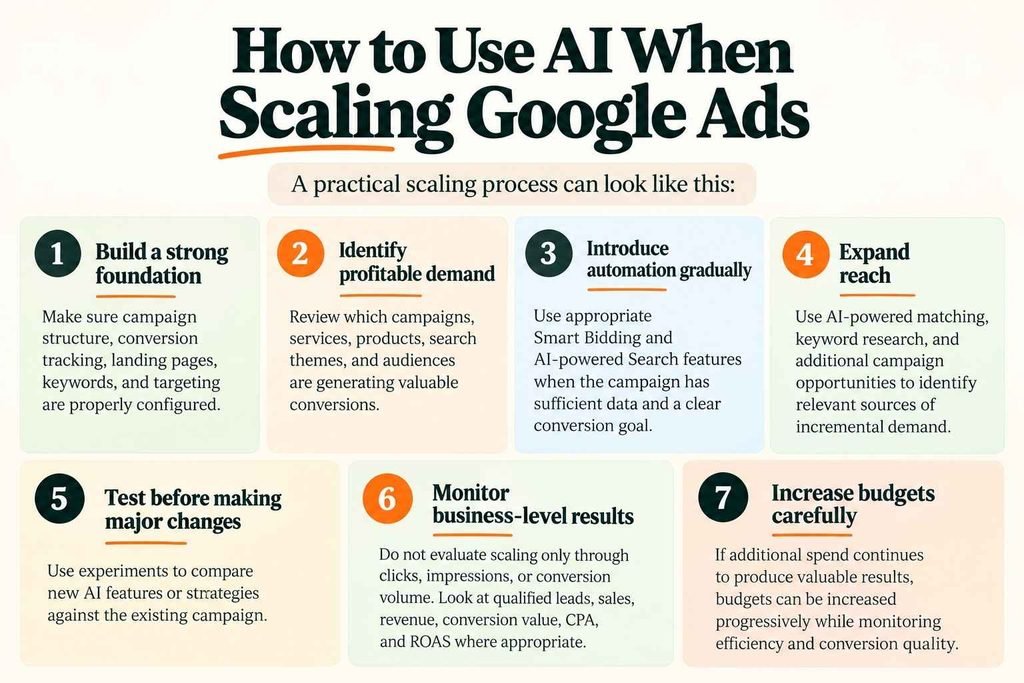
How to Use AI When Scaling Google Ads
A practical scaling process can look like this:
Step 1: Build a strong foundation
Make sure campaign structure, conversion tracking, landing pages, keywords, and targeting are properly configured.
Step 2: Identify profitable demand
Review which campaigns, services, products, search themes, and audiences are generating valuable conversions.
Step 3: Introduce automation gradually
Use appropriate Smart Bidding and AI-powered Search features when the campaign has sufficient data and a clear conversion goal.
Step 4: Expand reach
Use AI-powered matching, keyword research, and additional campaign opportunities to identify relevant sources of incremental demand.
Step 5: Test before making major changes
Use experiments to compare new AI features or strategies against the existing campaign.
Step 6: Monitor business-level results
Do not evaluate scaling only through clicks, impressions, or conversion volume. Look at qualified leads, sales, revenue, conversion value, CPA, and ROAS where appropriate.
Step 7: Increase budgets carefully
If additional spend continues to produce valuable results, budgets can be increased progressively while monitoring efficiency and conversion quality.
The Future of AI-Powered Google Ads Scaling
Google’s direction is increasingly focused on combining AI-powered targeting, creative optimization, and automated bidding.
Google currently recommends using AI Max for Search together with Smart Bidding when advertisers have accurate conversion measurement and conversion-focused goals.
At the same time, Google continues to provide reporting and experiment features so advertisers can understand how AI-driven changes affect performance. AI Max reporting includes search-term, keyword, asset, and landing-page information that can help advertisers evaluate campaign performance.
This suggests that successful scaling will not simply mean turning on every available AI feature. It will involve combining automation with good data, structured testing, and clear business objectives.
Final Thoughts
The role of AI in paid search is moving beyond simple automation. Modern Google Ads campaigns can use AI for bidding, search-term matching, creative optimization, audience signals, and campaign expansion.
For businesses exploring AI tools for Google Ads scaling, the most important consideration is how these technologies fit into the overall advertising strategy.
AI can help process more data, discover new opportunities, and reduce repetitive work. But accurate conversion tracking, strong offers, relevant landing pages, budget control, testing, and human strategic oversight are still essential.
The objective of scaling should therefore be more than spending a larger advertising budget. The goal is to build a system where automation can help identify and capture additional demand while the advertiser continues to measure whether that growth is producing meaningful business results.