 By Monir Hossen
For many healthcare businesses, getting found when someone is actively looking for a service can be more valuable than simply reaching a large audience.
Someone searching for “dentist near me,” “dental implants,” “urgent care clinic,” or “physical therapy near me” already has a reason to search. This is where Google Ads can help healthcare providers connect with potential patients at the right moment.
But running Google Ads for healthcare is different from running ads for a typical eCommerce or local business. Healthcare advertisers need to think about search intent, patient trust, conversion tracking, landing page quality, and Google’s healthcare advertising policies.
A well-planned google ads management for healthcare strategy brings these areas together instead of focusing only on clicks.
Why Google Ads Can Be Valuable for Healthcare Businesses
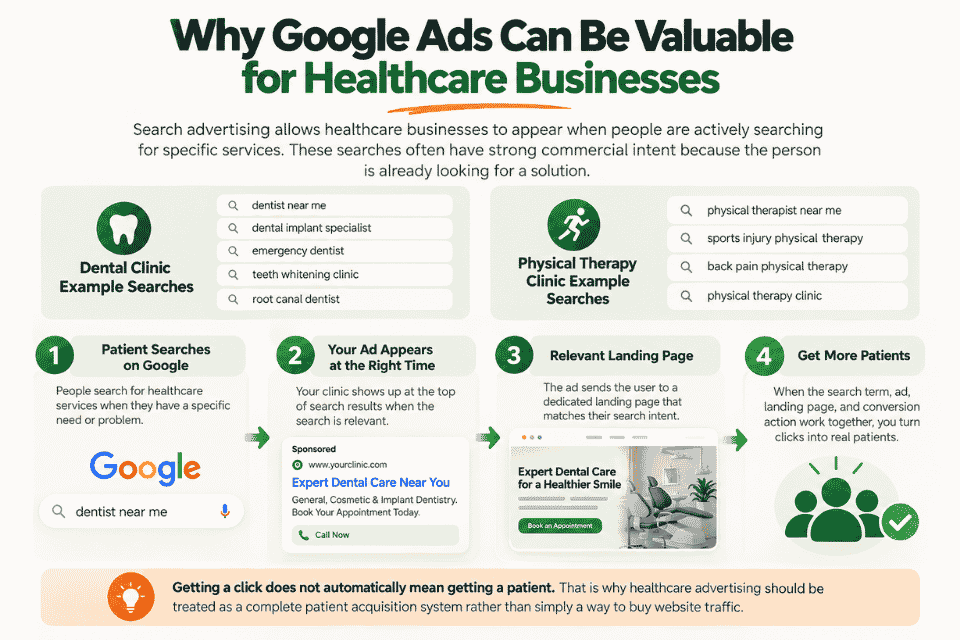
Search advertising allows healthcare businesses to appear when people are actively searching for specific services.
For example, a dental clinic may target searches such as:
- “dentist near me”
- “dental implant specialist”
- “emergency dentist”
- “teeth whitening clinic”
- “root canal dentist”
A physical therapy clinic may focus on searches such as:
- “physical therapist near me”
- “sports injury physical therapy”
- “back pain physical therapy”
- “physical therapy clinic”
These searches can have strong commercial intent because the person is already looking for a solution.
However, getting a click does not automatically mean getting a patient. The campaign needs to connect the search term, advertisement, landing page, and conversion action.
That is why healthcare advertising should be treated as a complete patient acquisition system rather than simply a way to buy website traffic.
What Does Google Ads Management for Healthcare Include?
Professional google ads management for healthcare usually involves much more than creating a few search campaigns.
A proper management process can include:
- Keyword research
- Search intent analysis
- Campaign and ad group structure
- Location targeting
- Negative keyword management
- Search ad creation
- Conversion tracking
- Call tracking
- Landing page analysis
- Budget management
- Bid strategy testing
- Search term analysis
- Performance reporting
- Ongoing campaign optimization
The exact setup depends on the healthcare business, its services, location, competition, budget, and conversion goals.
For example, a dental clinic focused on implants may need a different campaign structure from a general family practice. A multi-location healthcare organization may also require separate campaigns and location strategies.
Start With Search Intent, Not Just Keywords
One of the biggest mistakes in healthcare PPC is looking only at keyword volume.
A keyword can have thousands of monthly searches and still produce poor business results if the people searching it are not ready to take action.
For example, consider these searches:
“What are dental implants?”
and
“Dental implant dentist near me.”
The first search is more informational. The second has much stronger local service intent.
Both searches are related to dental implants, but they represent different stages of the patient journey.
A strong campaign separates these types of searches and focuses budget on the searches that are most relevant to the healthcare provider’s actual services.
Build Campaigns Around Services
Healthcare accounts often perform better when campaigns are organized around specific services rather than putting every keyword into one campaign.
For a dental practice, the structure could look something like:
Campaign 1: Dental Implants
Keywords related to dental implants and implant consultations.
Campaign 2: Emergency Dentistry
Keywords related to emergency dental treatment.
Campaign 3: General Dentistry
Keywords related to routine dental services.
Campaign 4: Cosmetic Dentistry
Keywords related to cosmetic procedures and treatments.
This structure makes it easier to create ads that closely match what people are searching for.
It also makes it easier to send users to relevant landing pages.
Landing Pages Matter as Much as the Ads
A common problem with healthcare PPC campaigns is sending every visitor to the homepage.
Imagine someone searches for “dental implants near me,” clicks an ad about dental implants, and then lands on a generic homepage where they have to search through several pages to find information about implants.
That creates unnecessary friction.
Google explains that landing page experience considers factors such as relevance, usefulness, navigation, and whether the page meets the expectations created by the ad. Landing page experience is also one of the components Google uses when evaluating Quality Score.
This is why google ads landing page optimization should be part of the campaign strategy.
A healthcare landing page should ideally:
- Match the service mentioned in the ad
- Explain the service clearly
- Have a strong and visible call to action
- Make contacting the provider easy
- Work well on mobile devices
- Load quickly
- Build trust
- Provide useful information
- Avoid unnecessary distractions
Google also recommends keeping the message consistent between the ad and landing page and making the landing page mobile friendly.
Make Patient Actions Easy
Healthcare leads often come through different actions.
Someone may:
- Call the clinic
- Submit an appointment form
- Request a consultation
- Book an appointment
- Ask for more information
- Click for directions
Your campaign should measure the actions that actually matter to the business.
For example, if phone calls are the primary source of new patients, measuring only form submissions would give an incomplete picture of campaign performance.
Google Ads provides conversion tracking tools that can measure actions people take after interacting with an advertisement. Google recommends implementing the Google tag and appropriate event or phone snippets for conversion tracking.
Why Conversion Tracking Is Critical
Without reliable conversion tracking, it becomes difficult to understand which campaigns and keywords are producing meaningful results.
You may see:
- 500 clicks
- 20,000 impressions
- A strong CTR
But those numbers do not tell you how many people actually contacted the healthcare provider.
A better measurement system connects advertising activity with business actions.
Depending on the healthcare business, important conversions may include:
- Phone calls
- Appointment requests
- Consultation forms
- Online bookings
- Contact form submissions
Tracking should be reviewed carefully because healthcare-related data can fall under Google’s sensitive-category policies. Google states that health or medical information is a sensitive category and that certain types of health-related conversion data have measurement restrictions.
For healthcare advertisers, tracking should therefore be planned with both performance measurement and privacy requirements in mind.
Google Ads and Healthcare Policies
Healthcare advertising requires extra attention to Google’s advertising policies.
Google states that some healthcare and medicine products or services are restricted and that certain categories require certification or approval before advertising. Requirements can also vary by location.
Some examples of regulated areas include:
- Prescription drug services
- Certain restricted drug terms
- Pharmaceutical manufacturers
- Addiction services
- Certain health insurance products
- Some medical treatments
- Certain reproductive health services
Healthcare advertisers should check the policies that apply to their specific service and target location before launching campaigns.
There are also restrictions around personalized advertising and health-related targeting. Google identifies health as a sensitive interest category and restricts the use of advertiser-curated audiences for sensitive health categories.
This means healthcare campaigns should not simply copy the targeting approach used for an ordinary eCommerce campaign.
Don’t Ignore Negative Keywords
Healthcare searches can be broad.
For example, a clinic offering paid dental services may receive searches related to:
- Jobs
- Careers
- Training
- Courses
- Schools
- Free treatment
- DIY treatment
- Products
- Research
- Definitions
Some of these searches may not have commercial value for the clinic.
Regular search-term analysis helps identify irrelevant queries and build a negative keyword list.
This can help reduce wasted spend and keep the campaign focused on relevant searches.
PPC Management Should Be Ongoing
Google Ads is not a “set it and forget it” platform.
Good ppc management involves reviewing campaign data regularly and making informed changes.
Some areas to review include:
- Search terms
- Keyword performance
- Conversion rates
- Cost per lead
- Click-through rate
- Cost per click
- Location performance
- Device performance
- Ad performance
- Landing page performance
- Budget allocation
The goal is not simply to get more clicks.
The goal is to understand which parts of the account are contributing to meaningful business results.
This is why google ads lead generation should focus on lead quality as well as lead volume.
A campaign generating 50 low-quality inquiries is not necessarily more useful than a campaign generating 15 inquiries from people who are genuinely interested in booking an appointment.
Google Ads Management vs. Simply Running PPC
There is a difference between launching a campaign and actively managing one.
A campaign can be launched in a few hours.
Managing it properly requires ongoing analysis.
For example, an account manager may discover that:
- One keyword spends heavily without producing leads
- Another keyword generates consistent appointment requests
- Certain locations produce better leads
- Mobile users convert at a different rate
- A specific search term is irrelevant
- One landing page performs better than another
- Some ads attract clicks but fewer qualified leads
These insights can then be used to improve the account.
This is where professional ppc management becomes valuable for healthcare businesses that depend on a steady flow of qualified inquiries.
Choosing a Google PPC Agency for Healthcare
If you are considering a Google PPC Agency, don’t look only at the number of clicks they promise.
Ask how they approach:
- Healthcare advertising policies
- Conversion tracking
- Call tracking
- Keyword research
- Negative keywords
- Landing pages
- Location targeting
- Lead quality
- Reporting
- Ongoing optimization
A good agency should be able to explain what is being measured and why.
It should also be clear about the difference between traffic metrics and actual business outcomes.
A Simple Healthcare Google Ads Framework
A practical healthcare PPC strategy can be built around five steps:
1. Identify Your Most Valuable Services
Start with the services that have real business value.
Not every service needs its own campaign immediately.
2. Research Search Intent
Find the searches that indicate someone is looking for the service, not simply researching a general topic.
3. Build Relevant Ads
Make the ad closely match the service and intent behind the search.
4. Send Traffic to Relevant Pages
Avoid sending every visitor to the homepage. Match the landing page to the service being advertised.
5. Measure and Optimize
Track meaningful conversions and regularly review search terms, costs, leads, and lead quality.
This process creates a stronger connection between the search, ad, landing page, and patient action.
Final Thoughts
Google Ads can be an important acquisition channel for healthcare businesses, but successful campaigns require more than selecting keywords and increasing budgets.
Healthcare advertisers need to consider search intent, campaign structure, ad relevance, landing page experience, conversion tracking, lead quality, and Google’s healthcare advertising policies.
The most effective approach is usually to treat the account as a complete system.
Your ads bring the right people to the website. Your landing pages help them understand the service. Your tracking tells you what actions they take. Your ongoing optimization helps you understand where the advertising budget is producing useful results.
When these parts work together, google ads management for healthcare becomes more than managing an advertising account. It becomes a structured way to connect people who are actively searching for healthcare services with the providers who can serve them.