
 By Monir Hossen

When people need legal help, they often start with Google. They may search for a personal injury lawyer, family lawyer, criminal defense attorney, immigration lawyer, or another legal service in their area.
This creates an opportunity for law firms to reach potential clients when they are actively looking for legal help. Google ads for lawyers can put a law firm in front of these high-intent searches and help turn relevant searches into calls, consultations, and website inquiries.
But getting results from paid search requires more than simply adding keywords and creating an ad. Law firms need the right campaign structure, relevant landing pages, accurate conversion tracking, and a clear process for handling new leads.
Why Google Search Ads Can Work for Law Firms
Google Search campaigns are designed to reach people who are actively searching for products or services. Google explains that Search campaigns can help businesses generate leads, sales, or website traffic by connecting with people searching for specific services.
For a law firm, this can be useful because search intent can be very specific.
For example, someone might search:
- Personal injury lawyer near me
- Family lawyer in [city]
- Criminal defense attorney
- Immigration attorney consultation
- Workers compensation lawyer
- Divorce attorney near me
- DUI defense lawyer
These searches can show that the person is already looking for legal assistance.
This is one reason google ads for law firms can be an important part of a client acquisition strategy.
However, not every search is equally valuable. A campaign should focus on searches that are closely connected to the firm’s services, location, and ideal client.
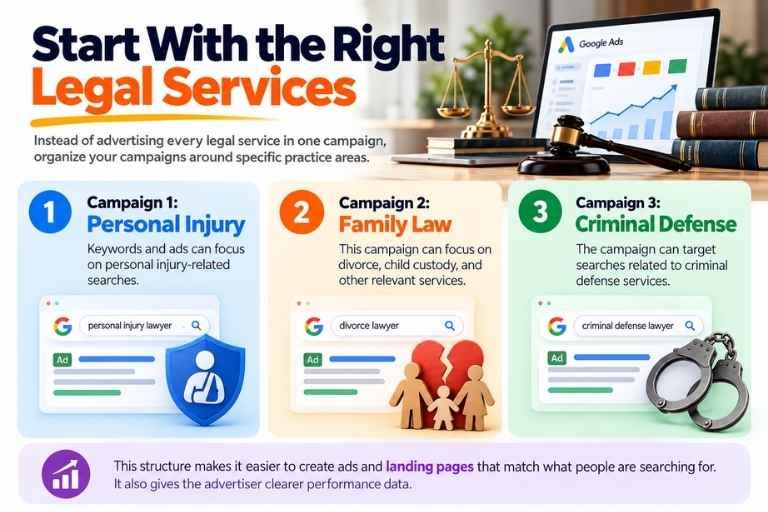
Start With the Right Legal Services
One common mistake is trying to advertise every legal service in one campaign.
A better approach is to organize campaigns around specific practice areas.
For example:
Campaign 1: Personal Injury
Keywords and ads can focus on personal injury-related searches.
Campaign 2: Family Law
This campaign can focus on divorce, child custody, and other relevant services.
Campaign 3: Criminal Defense
The campaign can target searches related to criminal defense services.
This structure makes it easier to create ads and landing pages that match what people are searching for.
It also gives the advertiser clearer performance data.
Choose Keywords Based on Search Intent
Keyword selection is one of the most important parts of a Search campaign.
A law firm should look beyond high search volume and consider the reason behind each search.
For example, a search such as:
“what is personal injury law”
may indicate someone looking for information.
A search such as:
“personal injury lawyer near me”
has a much stronger service intent.
Both searches may be related to the same topic, but they can represent very different stages of the user’s journey.
Build keyword groups around specific services, locations, and strong commercial intent.
It is also important to review actual search terms after the campaign starts. This helps identify irrelevant searches that may be consuming the budget.
Write Ads That Match the Search
Your ad should clearly communicate what the law firm offers.
For example, if someone searches for a family lawyer, the ad should focus on family law rather than making a general statement about legal services.
Useful ad elements can include:
- Practice area
- Location served
- Consultation information
- Relevant experience
- Clear call to action
- Important service details
Avoid making claims that cannot be supported.
Google’s advertising policies prohibit misleading claims and inaccurate information about businesses, services, qualifications, and affiliations. Google also states that advertisers should not guarantee outcomes or make unrealistic performance claims.
For legal advertising, this is especially important because professional rules and local laws can also apply.
Build a Relevant Landing Page
Sending every visitor to the homepage is not always the best approach.
If the ad is about personal injury services, the landing page should clearly explain the personal injury service.
A strong legal landing page can include:
- A clear headline
- Information about the legal service
- Areas served
- Attorney or firm information
- A phone number
- Consultation form
- Clear call to action
- Trust and credibility information
- Privacy information where appropriate
The landing page should also make it easy for visitors to understand what happens next.
For example:
Request a Consultation → Submit Your Information → Law Firm Contacts You
A simple path can reduce confusion and make lead handling easier.
Conversion Tracking Is Essential
Clicks and impressions are useful, but law firms ultimately need to know what happens after someone clicks an ad.
Google’s conversion tracking can measure valuable actions such as leads, phone calls, sign-ups, and other actions defined by the advertiser. It can also help identify which ads and keywords are producing those conversions.
For a law firm, possible conversion actions include:
- Phone calls
- Consultation form submissions
- Contact form submissions
- Appointment requests
- Qualified leads
- Calls that meet a minimum duration
Google also provides phone call conversion tracking that can help identify which keywords, ads, ad groups, and campaigns generate valuable calls.
This is important because a campaign can generate many clicks without generating many useful legal inquiries.
Track More Than Just Form Submissions
A form submission does not always mean a qualified client.
For example, a person may submit a form but:
- Be outside the firm’s service area
- Need a different type of legal service
- Have a case the firm does not handle
- Be looking for free legal information
- Be unable to become a client
This is why law firms should connect advertising data with their lead management process when possible.
Google also supports importing call conversion information so advertisers can connect phone calls with valuable customer actions.
This can help a firm understand which campaigns and keywords are producing meaningful calls rather than simply counting every call as equal.
Use the Right Bidding Strategy
Google provides several bidding options for Search campaigns.
The right approach depends on the campaign’s goals and the quality of its conversion data.
Google recommends setting up conversion tracking before using conversion-focused Smart Bidding. Its guidance explains that Smart Bidding can optimize toward conversions when accurate conversion tracking is available.
For a lead generation campaign, the important point is not simply choosing an automated bidding strategy. The campaign needs reliable conversion data and clearly defined conversion goals.
If the account is optimizing toward low-quality actions, Google’s automated bidding system can also learn from those actions.
That makes conversion setup an important part of google ads for lawyers.
Location Targeting Matters
Legal services are often location-based.
A law firm may only serve certain cities, counties, states, or regions. Campaign targeting should reflect where the firm actually accepts clients.
For example, a local family law firm may want to focus its advertising around its service area instead of spending its entire budget across a large geographic region.
Location targeting should be reviewed regularly because search traffic can come from different areas depending on campaign settings and user behavior.
Use Negative Keywords
Negative keywords can help prevent ads from showing for searches that are not relevant to the firm’s services.
For example, depending on the firm’s business model, negative keywords could include searches related to:
- Free legal advice
- Legal jobs
- Law school
- Legal courses
- Legal definitions
- Legal templates
- DIY legal documents
The exact negative keyword list should be based on the firm’s services and actual search-term data.
Regular search-term analysis can help identify new irrelevant queries that should be excluded.
Consider Lead Forms and Phone Calls
Some potential clients may prefer to call immediately. Others may prefer to submit their information online.
Google provides lead form assets that allow eligible advertisers to collect information directly through an ad. Google says lead forms can be used with Search campaigns and require a privacy policy link.
For law firms, the right lead method can depend on the practice area and the client’s preferred way of contacting the firm.
A campaign can potentially use:
- Website forms
- Phone calls
- Call assets
- Lead forms
- Consultation requests
The important part is tracking which sources generate qualified opportunities.
Follow Legal Advertising Rules
Law firms should consider both Google Ads policies and the professional rules that apply in their jurisdiction.
Google states that advertisers must comply with local laws and regulations in the locations they target.
Professional rules can also apply to lawyer advertising. For example, the American Bar Association’s Model Rules discuss advertising and electronic advertising, including advertising through the Internet. Individual jurisdictions may have their own requirements.
Before launching a campaign, a law firm should review the advertising rules that apply to its jurisdiction and practice area.
What a Strong Campaign Structure Can Look Like
A simple structure could look like this:
Campaign: Personal Injury
- Personal Injury Lawyer
- Personal Injury Attorney
- Car Accident Lawyer
- Accident Attorney
Campaign: Family Law
- Family Lawyer
- Divorce Lawyer
- Child Custody Lawyer
- Family Law Attorney
Campaign: Criminal Defense
- Criminal Defense Lawyer
- Criminal Defense Attorney
- DUI Lawyer
- Criminal Attorney
Each campaign can then have relevant ad groups, ads, keywords, landing pages, and conversion goals.
This structure makes performance analysis easier and helps keep the message relevant to the search.
Common Mistakes to Avoid
1. Sending All Traffic to the Homepage
A general homepage may not answer the visitor’s specific question.
2. Tracking Only Clicks
Clicks do not tell you how many qualified leads or calls were generated.
3. Using Broad, Irrelevant Keywords
High traffic does not automatically mean high-quality leads.
4. Ignoring Search Terms
Search-term data can reveal irrelevant queries and new opportunities.
5. Using Weak Conversion Tracking
If important calls and forms are not tracked correctly, campaign optimization becomes much harder.
6. Making Guaranteed Claims
Google does not allow misleading or unrealistic claims, including guarantees about outcomes or performance.
7. Ignoring Local Rules
Google’s policies do not replace the laws and professional advertising rules that apply to a law firm.
How Professional PPC Management Can Help
Managing legal search campaigns requires ongoing work.
A proper ppc management process can include:
- Keyword research
- Campaign structure
- Ad testing
- Search-term analysis
- Negative keyword management
- Location targeting
- Conversion tracking
- Landing page review
- Budget management
- Bid strategy monitoring
- Lead quality analysis
Google’s own guidance recommends monitoring campaign performance using metrics such as conversions, conversion rate, conversion value, cost per conversion, clicks, and CTR.
The goal should be to understand which parts of the account are generating valuable business results, not simply which keywords receive the most clicks.
Final Thoughts
Search advertising can give law firms a way to reach people who are actively looking for legal services.
The foundation is simple: target relevant searches, create useful ads, send visitors to relevant landing pages, track calls and forms, and regularly improve the campaign based on real conversion data.
Whether a firm manages its campaigns internally or works with a Google PPC Agency, accurate measurement should remain a priority.
With the right structure and ongoing optimization, paid search can become a measurable channel for generating new legal inquiries while keeping the focus on relevant searches and qualified leads.