 By Monir Hossen
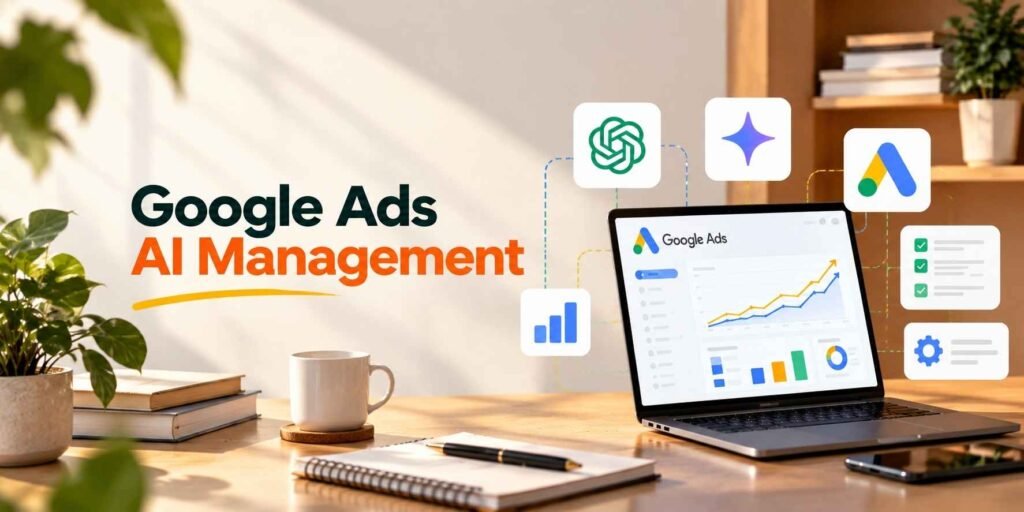
If you have opened your Google Ads account lately, you have probably noticed that things look different. Many settings are now “AI-powered,” some are turned on by default, and old features are disappearing.
This can feel confusing, and a little scary if you spend real money on ads every month. This guide explains what has changed, what to watch, and how to make smart choices.
Why AI Is Now a Big Part of Google Ads
Google has been adding AI to its ads for years. The biggest recent change is AI Max for Search campaigns.
It is not a new campaign type. Google says AI Max is an optimization layer inside your existing Search campaigns. New Search campaigns have it turned on by default. So if you created a campaign recently, AI Max may already be running.
According to Google, AI Max brings three things together:
- Wider keyword matching. It uses broad match and keywordless technology to find search queries you may have missed.
- Better ad text. It changes your ad creative based on what the customer is searching for, then sends them to the most relevant page on your site.
- Controls and reports. Google says you can still steer campaigns and see reports on what is happening.
Good google ads ai management starts with understanding these three parts. You cannot control what you do not understand.
What Do the Numbers Say?
Google’s own numbers look positive, but read them carefully. When AI Max launched, Google said advertisers would typically see 14% more conversions or conversion value at a similar CPA or ROAS. In a later update, Google said campaigns using the full feature suite (search term matching, text customization and final URL expansion) see about 7% more conversions than campaigns using search term matching alone.
These are Google’s numbers, and your results can be different. Treat them as a reason to test, not a promise.
There are also real case studies. Google shared that car maker BYD grew leads by 24% and cut costs by 26% using the new text guidelines for AI Max and Performance Max. Text guidelines let you tell the AI what it should and should not say in your ads. This is useful if your brand has strict rules.
Big Changes You Should Know About
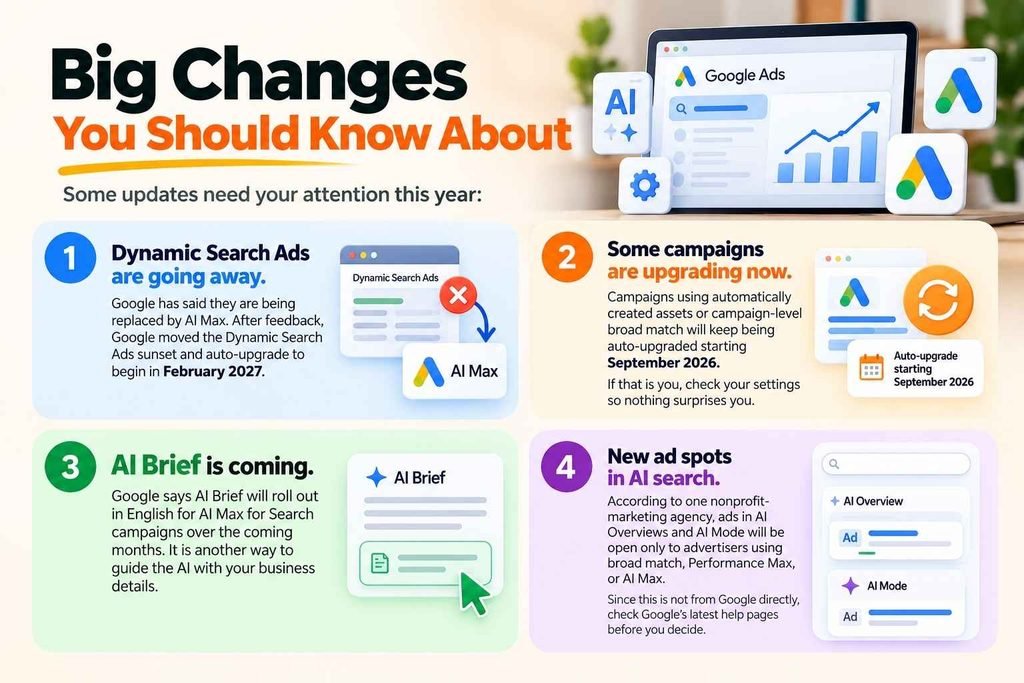
Some updates need your attention this year:
- Dynamic Search Ads are going away. Google has said they are being replaced by AI Max. After feedback, Google moved the Dynamic Search Ads sunset and auto-upgrade to begin in February 2027.
- Some campaigns are upgrading now. Campaigns using automatically created assets or campaign-level broad match will keep being auto-upgraded starting September 2026. If that is you, check your settings so nothing surprises you.
- AI Brief is coming. Google says AI Brief will roll out in English for AI Max for Search campaigns over the coming months. It is another way to guide the AI with your business details.
- New ad spots in AI search. According to one nonprofit-marketing agency, ads in AI Overviews and AI Mode will be open only to advertisers using broad match, Performance Max, or AI Max. Since this is not from Google directly, check Google’s latest help pages before you decide.
AI Still Needs Good Data
Here is the part many people miss. AI can only learn from the data you give it. If your tracking is wrong, the AI will learn the wrong lessons.
Google’s own help page says that with value-based bidding, you should upload values for 3 weeks or 1–2 conversion cycles, whichever is longer, before turning it on. Another Google page recommends picking one stage of your lead-to-sale funnel as your bidding goal, with a short conversion delay and at least 15 conversions a month.
For lead generation, this matters a lot. A form fill is not always a good lead. Spam and wrong-fit enquiries look like “conversions” to Google. One marketing guide points out that Enhanced Conversions for Leads lets you connect offline results, like qualified leads or closed deals, back to the original ad click, so Smart Bidding can aim for quality and not just volume.
The same guide warns about “conversion sprawl.” Many accounts mark everything as a primary conversion, like page views and button clicks, when most accounts should have only 1–3 primary actions that show real value.
A simple habit that helps: do a monthly tracking check. One Smart Bidding guide says a gap of more than 10% between your numbers usually points to a tracking problem.
A Simple Checklist for Safer AI Use
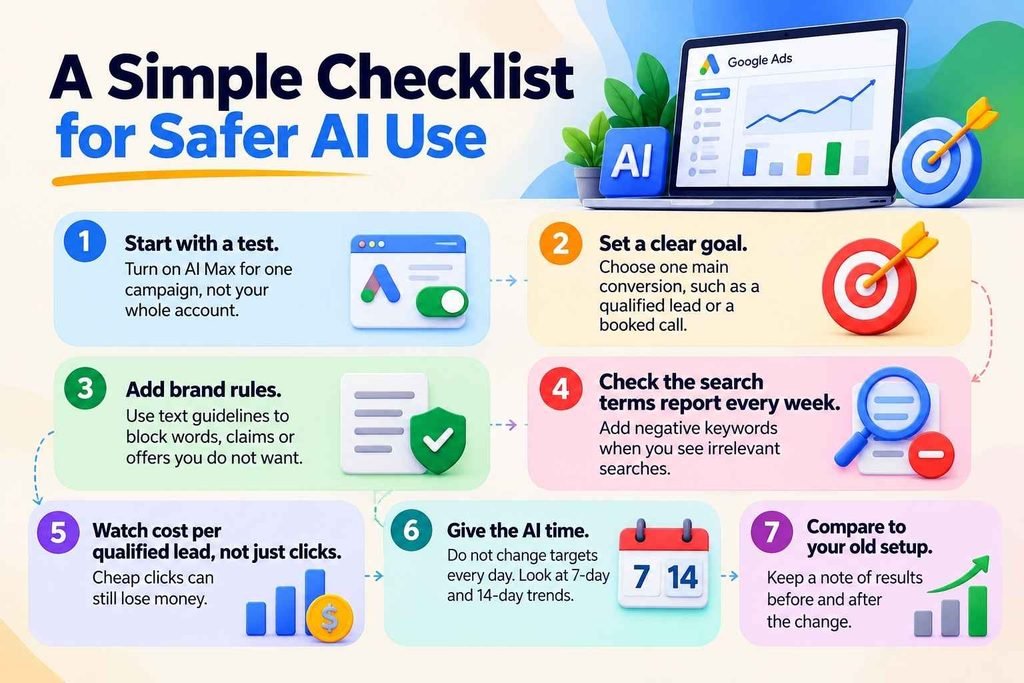
Here is a practical routine you can follow:
- Start with a test. Turn on AI Max for one campaign, not your whole account.
- Set a clear goal. Choose one main conversion, such as a qualified lead or a booked call.
- Add brand rules. Use text guidelines to block words, claims or offers you do not want.
- Check the search terms report every week. Add negative keywords when you see irrelevant searches.
- Watch cost per qualified lead, not just clicks. Cheap clicks can still lose money.
- Give the AI time. Do not change targets every day. Look at 7-day and 14-day trends.
- Compared to your old setup. Keep a note of results before and after the change.
Do You Need Help From an Agency?
You can run all of this yourself. But it takes time to read the updates, test, and fix mistakes. Google’s tools change fast, so many small businesses look for a Google PPC Agency that keeps up with each change and watches the account every week.
If you hire one, ask a few honest questions:
- How do you track lead quality, not just lead count?
- Will I have full access to my own Google Ads account?
- How often will you report, and what numbers will you show me?
- How do you test new features like AI Max before using them widely?
A good partner will explain things in plain words and will not hide behind the word “AI.”
Final Thoughts
Good google ads management today is a mix of AI power and human judgment. Google’s tools can find more searches, write more ad versions and adjust bids faster than any person. But you still decide the goal, the budget, the brand voice and what counts as a good lead. That is also the heart of modern ppc ads management.
Keep your tracking clean, test in small steps, and read your reports every week. That is how google ads ai management works best: the AI does the heavy lifting, and you stay in charge of the direction.